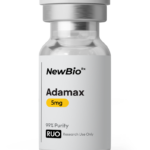
What is Adamax?
What is Adamax?
Adamax is a research compound with well-documented chemical properties. This compound has the molecular formula C28H30F3N7O3 and a molecular weight of 569.6 g/mol.Chemical Identity
The compound is characterized by its unique molecular structure and specific chemical properties that make it valuable for research applications.
Systematic IUPAC Name:
N-[6-[4-[[4-[(4-methylpiperazin-1-yl)methyl]-3-(trifluoromethyl)phenyl]carbamoylamino]phenoxy]pyrimidin-4-yl]cyclopropanecarboxamide
Research Applications
Adamax is widely used in scientific research and laboratory studies. Researchers utilize this compound to investigate various biochemical pathways, mechanisms of action, and potential applications in different fields of study.Purity & Quality
Our Adamax is provided at research-grade purity, suitable for laboratory applications and experimental protocols. Each batch undergoes quality control testing to ensure consistency and reliability for your research needs. Important: This product is intended for research purposes only and is not for human or veterinary use. It is sold for laboratory and scientific investigation only.Adamax Structure
Chemical Structure
2D Structure

3D Structure

Chemical Properties
| CAS Number | 1421227-52-2 |
|---|---|
| Molecular Formula | C28H30F3N7O3 |
| Molecular Weight | 569.6 g/mol |
| IUPAC Name |
N-[6-[4-[[4-[(4-methylpiperazin-1-yl)methyl]-3-(trifluoromethyl)phenyl]carbamoylamino]phenoxy]pyrimidin-4-yl]cyclopropanecarboxamide
|
| InChIKey | KIKOYRNAERIVSJ-UHFFFAOYSA-N |
Adamax Research
Scientific Research
The following peer-reviewed research articles have been published about Adamax:
1. Enhancing accuracy in brain stroke detection: Multi-layer perceptron with Adadelta, RMSProp and AdaMax optimizers.
Uppal M et al.. Enhancing accuracy in brain stroke detection: Multi-layer perceptron with Adadelta, RMSProp and AdaMax optimizers. Front Bioeng Biotechnol. 2023;11:1257591. PMID: 37823024
2. Effective skin cancer classification by modified and optimized inception-ResNet-V2 model.
Umapathi K et al.. Effective skin cancer classification by modified and optimized inception-ResNet-V2 model. Sci Rep. 2025;15(1):41150. PMID: 41266780
3. Artificial Intelligence-based fine-tuning model for fall activity recognition in disabled persons within an IoT environment.
Alzahrani A et al.. Artificial Intelligence-based fine-tuning model for fall activity recognition in disabled persons within an IoT environment. Sci Rep. 2025;16(1):694. PMID: 41326571
4. Using meta-analysis and CNN-NLP to review and classify the medical literature for normal tissue complication probability in head and neck cancer.
Lee TF et al.. Using meta-analysis and CNN-NLP to review and classify the medical literature for normal tissue complication probability in head and neck cancer. Radiat Oncol. 2024;19(1):5. PMID: 38195582
5. An intelligent LinkNet-34 model with EfficientNetB7 encoder for semantic segmentation of brain tumor.
Sulaiman A et al.. An intelligent LinkNet-34 model with EfficientNetB7 encoder for semantic segmentation of brain tumor. Sci Rep. 2024;14(1):1345. PMID: 38228639
6. A robust stacked ensemble strategy with multi-optimizer CNN models for skin cancer classification.
Panwar A et al.. A robust stacked ensemble strategy with multi-optimizer CNN models for skin cancer classification. Sci Rep. 2026; PMID: 42151239
7. Deep learning model for early acute lymphoblastic leukemia detection using microscopic images.
Anand V et al.. Deep learning model for early acute lymphoblastic leukemia detection using microscopic images. Sci Rep. 2025;15(1):29147. PMID: 40783578
8. Diagnosis of Autism Spectrum Disorders in Young Children Based on Resting-State Functional Magnetic Resonance Imaging Data Using Convolutional Neural Networks.
Aghdam MA, Sharifi A, Pedram MM. Diagnosis of Autism Spectrum Disorders in Young Children Based on Resting-State Functional Magnetic Resonance Imaging Data Using Convolutional Neural Networks. J Digit Imaging. 2019;32(6):899-918. PMID: 30963340
9. Augmented Multimodal Fusion for Optimized Brain Tumor Detection: Evaluation and Comparative Analysis.
Tuteja P et al.. Augmented Multimodal Fusion for Optimized Brain Tumor Detection: Evaluation and Comparative Analysis. J Vis Exp. 2025;(220) PMID: 40587439
10. Signal-to-noise ratio to assess magnitude, kinetics and impact on pharmacokinetics of the immune response to an adalimumab biosimilar.
Guerrieri D et al.. Signal-to-noise ratio to assess magnitude, kinetics and impact on pharmacokinetics of the immune response to an adalimumab biosimilar. Bioanalysis. 2024;16(1):33-48. PMID: 38031738
Disclaimer: The research articles listed above are for informational purposes only.
This product is intended for research use only and not for human or veterinary use.